Source Hot Press Diamond Saw Blade for Marble, Granite, Ceramic
Source 30 hot press diamond saw blade options for cutting marble, granite, and ceramic. Compare segment widths, arbor sizes, and customization features from verified Chinese manufacturers to find the right power tool parts for your needs.
Key considerations
Products List




Comprehensive Sourcing Guide
Strategic Sourcing Guide for Hot Press Diamond Saw Blades
Understanding the Core Technology and Manufacturing Process
The foundation of effective procurement for hot press diamond saw blades lies in understanding the specific manufacturing methodology known as sintering via hot press. This process is distinct from electroplating or laser welding, offering a unique balance of bond strength and abrasive retention. In the context of the available market data, the manufacturing process is explicitly identified as "Sintered" with a specific process type noted as "HOT PRESS." This technique involves compacting a mixture of diamond grit and a metal bonding agent under high temperature and pressure. The result is a blade segment where the diamond particles are firmly locked into the metal matrix, creating a robust cutting tool capable of withstanding high mechanical stress.
The choice of a hot press method is particularly relevant for applications requiring durability and consistent performance. The bonding agent utilized in these blades is consistently described as "Metal," which is essential for the structural integrity of the segment. Unlike softer bonds that wear away quickly to expose fresh diamonds, the metal bond in hot-pressed blades is engineered to wear at a rate that matches the fracture of the diamond grit, ensuring a self-sharpening action. This is critical for cutting hard materials like granite and marble, where the abrasive action must be sustained over long periods. Buyers must verify that the supplier's production line utilizes this specific hot press sintering technique, as it directly influences the blade's ability to maintain a straight cut and resist warping under load.
Technical Specifications and Dimensional Variability
When sourcing hot press diamond saw blades, technical specifications are the primary filter for compatibility with existing machinery and intended tasks. The market data reveals a significant range of dimensional options, indicating that these blades are not one-size-fits-all but are highly customizable to specific operational needs. The product models listed span a wide spectrum of diameters, ranging from small handheld tools to large industrial saws. Specific models identified include the XFDH0S115 (115mm), XFDH0S125 (125mm), XFDH0S230 (230mm), XFDH0S300 (300mm), and XFDH0S400 (400mm), alongside a general category covering diameters from 4 to 10 inches.
The arbor size, or the hole in the center of the blade, is another critical specification that must match the spindle of the power tool. The observed data indicates a high degree of flexibility in this area, with arbor sizes ranging from 20mm up to 50mm, including standard metric and imperial sizes such as 22.23mm, 25.4mm, and 27mm. This variability suggests that buyers must carefully cross-reference their equipment's specifications with the supplier's inventory to ensure a proper fit. Additionally, the segment width and height vary by model, with segment widths observed at 1.9mm, 2.0mm, 2.6mm, and 3.2mm, and segment heights noted as 5/7mm or 7/10mm. These dimensions directly affect the kerf width and the depth of cut, influencing both material waste and cutting speed.
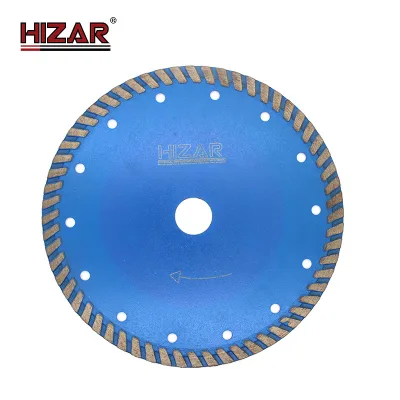
The cross-sectional shape of the blade is consistently observed as rectangular, and the overall shape is flat. This geometry is standard for general-purpose cutting but requires precise manufacturing to ensure the blade does not wobble during operation. The cutting thickness is described as a "multi choice" option, implying that buyers can select specific thicknesses based on their material hardness and the required finish. Furthermore, the blade length is noted as "Customized," reinforcing the need for buyers to communicate specific requirements rather than relying solely on standard catalog items.
Application Scope and Material Compatibility
The versatility of hot press diamond saw blades is a key factor in their widespread adoption across various industries. The primary applications identified in the market data include cutting marble, granite, and ceramic. These materials represent a spectrum of hardness and abrasiveness, requiring a blade that can adapt to different cutting conditions. The "Multipurpose Cutting" feature highlighted in the product attributes suggests that these blades are designed to handle a variety of stone types without the need for frequent blade changes.
The material composition of the blade, described as "Metal + Diamond," is specifically engineered to tackle these challenging substrates. The diamond abrasive provides the cutting edge, while the metal bond holds the diamonds in place. The application of these blades extends to power tool parts, indicating their use in both stationary saws and handheld angle grinders. The specific mention of "Cutter Head" as the blade type further clarifies that these are segments designed to be mounted onto a larger body or used as a complete unit depending on the machinery.
Buyers should consider the specific demands of their cutting environment. For instance, cutting granite requires a harder bond to prevent the diamonds from being pulled out too quickly, whereas cutting softer marble might benefit from a slightly softer bond to expose fresh diamonds more rapidly. The "High Quality" attribute observed in the listings suggests that suppliers aim to meet these diverse demands, but buyers must verify that the specific segment formulation matches their primary material. The ability to customize the blade, including color and specific dimensions, allows for tailoring the tool to specific project requirements, ensuring optimal performance and longevity.
Cost Drivers and Pricing Dynamics
Understanding the cost structure of hot press diamond saw blades is essential for budgeting and supplier negotiation. The observed price range in the market spans from $0.45 to $50 USD, a wide variance that reflects differences in size, material quality, and customization levels. The lower end of the spectrum likely corresponds to smaller, standard-sized blades with minimal customization, while the higher end represents larger industrial blades, custom configurations, or premium quality segments.
Several factors drive these costs. The amount of diamond content is a primary determinant; blades with higher diamond concentrations generally command higher prices due to the cost of the abrasive material. The manufacturing process, specifically the hot press sintering, adds value through the energy and equipment costs involved in creating a durable bond. Customization options, such as specific segment widths, heights, and arbor sizes, also influence the final price. Additionally, packaging plays a role; options range from simple cartons to more protective "White Box Double Blister" or "Double Corrugated Carton" packaging, which adds to the overall cost but ensures the product arrives in perfect condition.
The Minimum Order Quantity (MOQ) is another critical cost driver, with observed ranges from 1 to 1000 units. Buyers seeking small quantities may face higher per-unit costs or limited availability, while those ordering in bulk can leverage economies of scale. The payment method, typically T/T (Telegraphic Transfer), is standard in the industry but requires buyers to manage cash flow and trust dynamics with the supplier. It is important to note that while the price range is broad, the actual cost for a specific order will depend on the exact specifications requested and the volume purchased.
Supplier Evaluation and Quality Assurance
Selecting the right supplier for hot press diamond saw blades requires a rigorous evaluation process that goes beyond price comparisons. The origin of the products is consistently noted as China, with specific delivery locations in Jiangsu, a region known for its manufacturing capabilities. Buyers should verify the supplier's production capacity and their ability to maintain consistent quality across large orders. The "High Quality" attribute is a common claim, but it must be substantiated through tangible evidence such as sample testing or third-party validation.
Quality control should focus on the integrity of the hot press sintering process. Buyers should request documentation or samples that demonstrate the bond strength and the uniformity of the diamond distribution within the segment. The manufacturing process type, specifically "HOT PRESS," should be confirmed as a standard operating procedure for the supplier, rather than an occasional capability. Additionally, the finishing process, described as "Other" in the data, warrants clarification to ensure it meets the buyer's standards for surface finish and dimensional accuracy.
Compliance and certification checks are also vital, although specific certification status should be treated with caution. While CE certification is mentioned in the background data, it should not be assumed as a guaranteed attribute for every listed product. Buyers must explicitly request certification documents for the specific models they intend to purchase. The standardization of the product, often referenced by the model number or standard dimension (e.g., 700mm, 4.5inch), provides a baseline for quality, but buyers should verify that the supplier adheres to these standards consistently.
Long-Term Procurement and Operational Considerations
Sourcing hot press diamond saw blades is not merely a transactional activity but a strategic decision that impacts long-term operational efficiency. The customization options available, including color, segment dimensions, and blade length, allow buyers to optimize their procurement strategy for specific, recurring tasks. This flexibility can lead to reduced downtime and improved cutting performance over time. However, it also requires a robust relationship with the supplier to ensure that custom orders are fulfilled accurately and consistently.
The delivery location in Jiangsu, China, suggests a well-established logistics network, but buyers should still verify lead times and shipping reliability. The packaging options, ranging from cartons to double corrugated boxes, play a crucial role in protecting the blades during transit, especially for larger or more delicate models. Ensuring that the packaging is adequate for the specific shipping method is essential to prevent damage and maintain the blade's quality upon arrival.
Payment terms, typically T/T, require careful management to balance risk and cash flow. Buyers should establish clear communication channels with the supplier to address any issues regarding quality, delivery, or specifications promptly. The ability to customize the product, including the segment width and height, offers a competitive advantage by allowing buyers to tailor the blade to their specific machinery and material requirements. This level of customization can lead to significant cost savings in the long run by extending the life of the blade and reducing material waste.
In conclusion, sourcing hot press diamond saw blades requires a deep understanding of the technical specifications, manufacturing processes, and application requirements. By focusing on the core attributes such as the hot press sintering method, metal bonding agent, and customizable dimensions, buyers can make informed decisions that align with their operational goals. The wide range of available models and specifications provides ample opportunity to find the perfect fit for any cutting application, provided that thorough supplier evaluation and quality assurance measures are implemented.
FAQs
What manufacturing process is used for these blades?
These blades use a hot press sintering process to bond diamond grit to a metal matrix. This method ensures high durability and consistent performance for cutting hard materials like granite and marble effectively.
Which arbor sizes are available for these saw blades?
Available arbor sizes include 20mm, 22.23mm, 25.4mm, 27mm, and 50mm to fit various power tools. Buyers must verify their machine spindle dimensions to ensure a proper fit before ordering specific models.
Can I customize the segment width and height?
Yes, customization is available for segment dimensions such as widths ranging from 1.9mm to 3.2mm and heights of 5/7mm or 7/10mm. This allows tailoring the blade to specific cutting depths and material requirements.
What materials can these blades cut effectively?
These blades are designed to cut marble, granite, and ceramic materials efficiently. The metal bond and diamond abrasive composition provide the necessary hardness and wear resistance for these diverse stone types.
How does the pricing vary for different models?
Prices range from 0.45 to 50 USD depending on size, customization, and material quality. Larger industrial blades and custom configurations typically command higher prices compared to smaller standard units.
What packaging options are provided for shipping?
Packaging options include standard cartons, white box double blister packs, and double corrugated cartons. The choice depends on the blade size and the need for protection during transit to prevent damage.